Writing
Writing under a deadline
The blank page problem is a planning failure rather than a creative one, and it has practical solutions.
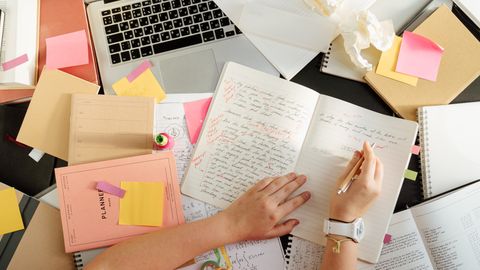
Most writing that has to be finished by a date fails not because it was difficult but because the process was left undesigned.
Separating the stages
The most useful single principle.
Planning, drafting and editing are different activities requiring different states of mind, and attempting them simultaneously is what produces paralysis.
Which means: decide what you are saying before writing sentences; write badly and quickly; then fix it.
Editing while drafting is the most common cause of a blank page, since every sentence is judged before the next one exists.
Planning
Which is where the time is saved.
Write the conclusion first, in one sentence, since if you cannot you do not know what you are writing.
List the sections as questions the reader will have.
Put them in the order the reader needs, which is rarely the order you researched them.
Allocate a rough word count to each.
And identify the section you are least sure about, since it is the one that will consume the time.
The bad first draft
Which is the technique, not a concession.
Write quickly, without stopping, without looking back.
Leave gaps marked rather than stopping to research: a placeholder for a figure or a name.
Write the easiest section first, since starting anywhere breaks the block.
Do not adjust the wording.
The objective is a complete bad draft, which is infinitely more workable than a perfect opening paragraph and nothing else.
Editing
As a separate pass, or several.
Structure first: is the order right, is anything missing, is anything redundant?
Then argument: does each section support the conclusion?
Then paragraphs: does each one make one point, stated first?
Then sentences: length, clarity, unnecessary words.
Then proofreading, last, since correcting typos in text you will delete is wasted.
Doing these in one pass produces a document that is well-proofread and badly structured.
Managing the time
Working backwards from the deadline.
Reserve at least a third of the available time for editing, which almost nobody does.
Set an internal deadline for the draft, earlier than the real one.
Build in a gap between drafting and editing — a night if possible — since you cannot see your own text immediately.
And allow for the review cycle if others must see it, which is generally underestimated.
Procrastination
The diagnosis matters.
Not knowing what to say: go back to planning, which is the actual blockage.
Fear of it being bad: lower the standard for the draft explicitly.
The task being too large: break it into a section you can finish in an hour.
Genuine competing priorities: schedule it rather than fitting it in.
And a task that is unpleasant rather than difficult: do it first in the day, which is the only reliable answer.
Working conditions
Which affect output more than motivation does.
A fixed time rather than waiting for a suitable moment.
Notifications off entirely, since a single interruption costs considerably more than its duration.
A defined session length — an hour, ninety minutes — with a break after.
Stopping mid-sentence rather than at a natural end, which makes restarting easy.
And noting what comes next before stopping, so the next session begins immediately.
When it is much too long
The common late-stage problem.
Cut whole sections rather than trimming words, which is more effective and less painful than it sounds.
Move detail to an appendix.
Delete the introduction, which is frequently redundant once the piece exists.
Cut examples to one where you have three.
And accept that material can be good and still not belong, which is the hardest editorial judgement.
Handing it over
The last stage.
Read it aloud once, which catches what silent reading does not.
Check the things that cause real damage: names, numbers, dates, the recipient's title.
Check that the request or conclusion is in the first paragraph.
Send it rather than continuing to polish, since the returns fall off sharply and the deadline is real.
And note afterwards which stage took longest, which is how the next one is planned better.
Also by Mei-Lin Chow
- Listening in a language you are learningLanguages
- Reading in another languageLanguages
- Keeping a language you already haveLanguages
- Writing that persuadesWriting