Public Speaking
Speaking without slides
Slides are a crutch that frequently damages the talk, and the alternative is more straightforward than it appears.
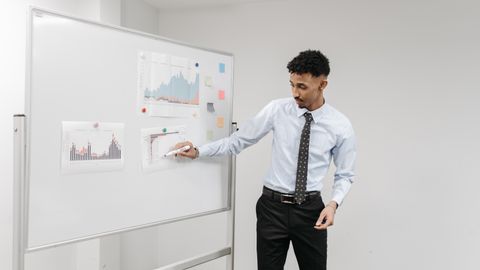
The default assumption that a talk requires slides has produced a great many presentations that would have been better as conversations.
What slides do badly
The recurring failures.
Text-heavy slides that the speaker reads aloud, which is slower than the audience can read and which means they are simultaneously reading and listening — and doing both badly.
Research on cognitive load and on the redundancy effect consistently finds that presenting identical information in spoken and written form simultaneously impairs comprehension rather than reinforcing it.
Slides as speaker notes, which means the speaker faces the screen.
Slide count driving talk length rather than content.
And complex charts that cannot be read from the back and are not explained.
When slides genuinely help
The legitimate uses.
Images that could not be described.
Data that must be seen: a chart showing a trend, a comparison between figures.
Diagrams of structures or processes.
A small number of words worth having on screen: a definition, a quotation, a single figure.
And demonstration of something visual.
Which is a considerably shorter list than most decks contain.
Preparing to speak without them
What replaces them.
A clear structure, since without visual signposting the verbal signposting must do all the work.
Explicit transitions: "that is the first of three; the second is…"
Numbering, stated and referred back to.
Concrete examples in place of bullet points, since a story is remembered where a list is not.
And knowing the material well enough that notes are a prompt rather than a script.
Notes without slides
Practical.
Cards, numbered, with one section per card.
Keywords rather than sentences, except for the opening and closing which can be written in full.
Large text.
Held rather than left on a lectern if you intend to move.
And rehearsed enough that glancing down is a reminder rather than a search.
Holding attention without visuals
The techniques.
Vary the pace and volume, since monotone loses an audience regardless of content.
Use pauses deliberately.
Tell a story roughly every few minutes, which resets attention.
Ask questions, rhetorical or real.
Address individuals with eye contact rather than scanning.
Move deliberately rather than pacing.
And use gesture, which is natural when not holding a clicker and reading a screen.
If you must use slides
Making them better.
One idea per slide.
Very few words — a heading and an image rather than bullets.
Large text, readable from the back of the room.
Charts simplified to the single point they make, with the point stated in the title.
A blank or black slide when you want attention on you rather than the screen, which most presentation software supports with a keystroke.
And notes in the presenter view rather than on the slide itself.
The handout alternative
Which resolves the tension.
Detail belongs in a document, distributed afterwards, which can be read at the reader's pace.
The talk can then do what talks do well: convey the argument, the significance and the enthusiasm.
Distributing beforehand means people read rather than listen; distributing afterwards means they listen and then have the detail.
Which is a small logistical decision with a substantial effect.
Whiteboards and flip charts
An underused middle ground.
Drawing something while explaining it holds attention in a way a prepared slide does not, since the audience watches it develop.
It paces the explanation naturally.
It allows adaptation to the room.
And it removes the technology risk entirely.
The requirements: legible writing, large enough to be seen, and not talking to the board.
The technology failure
Which happens.
Anyone who can deliver their talk without slides can survive the projector failing, the file not opening, or the room having no screen.
Which is a practical argument for preparing that way regardless.
And a speaker who continues smoothly when the technology fails gains considerable credibility, which is an odd consolation and a real one.
The test
Before building a deck.
Could you give this talk with no slides at all?
If not, the structure is in the slides rather than in your head, which means the audience is watching a document being read.
Build the talk first, then add only the visuals that show something words cannot.
Also by Esme Carrington
- The stories organisations tell about themselvesStorytelling
- Conversations with people much older or youngerConversation
- Speaking to cameraPublic Speaking
- Structuring a longer storyStorytelling