Public Speaking
The first minute
Openings are the most disproportionately valuable part of a talk and the part most often wasted on housekeeping.
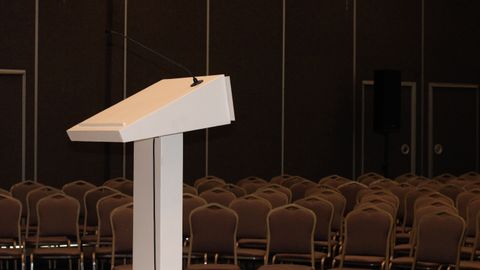
An audience decides how much attention to give within the first minute, and most speakers spend that minute apologising and introducing themselves.
What the first minute is for
Its actual functions.
Establishing that this is worth attention.
Establishing what the talk is about.
Establishing that you are worth listening to.
Setting the tone.
And getting your own nerves under control, which happens if the opening is memorised and does not if it is improvised.
What it is not for
The standard waste.
Thanking the organisers at length.
Explaining who you are, which the introduction covered.
Apologising for the technology, for being nervous, or for not being an expert.
Describing the structure of the talk in detail before there is any reason to care.
Housekeeping about breaks and fire exits, which belongs to whoever introduced you.
And "before I start", which means you have started and are wasting it.
Openings that work
The reliable forms.
A specific story, entered immediately without preamble, that contains the problem the talk addresses.
A striking fact or number, stated plainly and then unpacked.
A question the audience genuinely has, stated better than they would state it.
A direct challenge to an assumption the room holds.
The conclusion first, stated flatly, followed by the case for it.
Each of these gives the audience a reason to keep listening within seconds rather than minutes.
The story opening specifically
Since it is the most used and most often botched.
Start inside the scene rather than with the setup: "It was four in the afternoon and the system had been down for six hours" rather than "I want to tell you about something that happened a few years ago when I was working at—".
Keep it under ninety seconds.
Make its connection to the talk explicit at the end, in one sentence.
And ensure it earns its place rather than being a warm-up before the real content.
Memorising it
The practical requirement.
The first thirty seconds should be word-perfect and delivered without notes.
Which gives you something to hold on to while the adrenaline is highest, and which lets you make eye contact from the start.
Rehearse it more than any other part.
And having it fixed means that even a bad start recovers, since you are not improvising while anxious.
Before you speak
The moments immediately prior.
Walk to your position without hurrying.
Stand still, look at the room, and wait until it is quiet.
Take one breath.
Then begin.
The three seconds of stillness before the first word does more for perceived authority than anything in the talk, and almost nobody uses it.
Establishing why you
Credibility without a biography.
One sentence, embedded rather than announced: the number of times you have done this, the thing you built, the people you have worked with.
Stated once and moved past.
Which is more effective than a list of credentials and considerably less irritating.
And where you have no formal standing, the honest version — "I am not a specialist; I spent a year trying to solve this" — works better than a claim that will not hold.
Signposting
Which comes after the hook, not before it.
Once the audience is interested, telling them the structure helps: three parts, roughly this long, questions at the end.
Brief — two sentences.
And genuinely predictive, since a stated structure that is not followed is worse than none.
Openings for other formats
The same principle applied.
A meeting: the decision required, first sentence.
A written piece: the conclusion or the striking specific, first line.
A pitch: the problem, stated as the listener experiences it.
A conversation: the point, before the context.
In every case, the same failure — preamble — and the same fix.
Recovering a bad start
Which happens.
Stop, pause, and start the sentence again, which the audience barely registers.
Do not apologise or explain.
If the technology has failed, say what you are doing about it in one sentence and continue.
And remember that the audience wants you to succeed, which is true, is easy to forget, and changes how the first minute feels.
Also by Esme Carrington
- The stories organisations tell about themselvesStorytelling
- Conversations with people much older or youngerConversation
- Speaking to cameraPublic Speaking
- Structuring a longer storyStorytelling