Voice & Accent
Speaking on recordings and calls
The medium removes most of the signals you rely on, which changes what the voice has to do.

Speaking into a microphone or camera is a different task from speaking to a room, and treating it as the same produces the flat delivery that characterises most recorded speech.
What the medium removes
The signals you lose.
Audience feedback: no visible reactions, no sense of whether anything is landing.
Physical presence, which carries a great deal in a room.
Peripheral information: gesture, movement, the whole body.
And the shared space that makes an audience an audience rather than isolated individuals.
Which means the voice has to carry more, and the absence of feedback removes the natural adjustment a speaker makes in a room.
Energy
The most common problem.
Delivery that feels normal to the speaker sounds flat on a recording, because the natural energy produced by a room is absent.
Which means deliberately raising energy above what feels natural — more variation in pitch, more emphasis, more warmth.
It feels excessive while doing it and sounds normal on playback, which is the calibration everyone has to find by recording themselves.
Smiling while speaking is audible and changes the tone measurably.
And standing rather than sitting produces more energy and better breath support.
Microphone technique
Which affects the sound more than the equipment does.
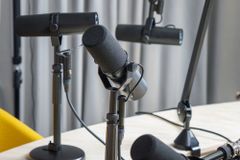
Consistent distance, generally a hand's width, since moving changes the volume and tone constantly.
Slightly off-axis rather than directly in front, which reduces plosive sounds.
Not touching the desk the microphone is on, since vibration transmits.
Not rustling papers or clicking pens.
And a pop filter or foam cover, which is inexpensive and eliminates the most common recording problem.
The room
Which matters more than the microphone.
Hard parallel surfaces produce reflections that make speech sound distant and hollow.
Soft materials absorb them: curtains, carpet, cushions, bookshelves with books, a wardrobe of clothes.
A small furnished room generally sounds better than a large empty one.
Which means recording in a room with soft furnishings, away from windows and hard walls, produces a better result than an expensive microphone in a bare one.
And background noise — traffic, fans, appliances, ventilation — is more noticeable on a recording than in the room.
Video calls specifically
Practical points.
Camera at eye level, which requires raising a laptop, since looking down at a camera is unflattering and reads as disengagement.
Light on your face rather than behind you, which means facing a window rather than sitting in front of one.
Look at the camera when speaking and at the screen when listening, which approximates eye contact.
Frame yourself with head and shoulders, with a little space above.
Use headphones, which eliminates echo for everyone else.
And mute when not speaking in larger calls.
Pacing on calls
Which differs from a room.
Latency means natural turn-taking breaks down, producing the characteristic interruption and pause pattern.
Which means pausing slightly longer before speaking, and after finishing.
Being explicit about turn-taking: naming who should speak next, asking directly rather than waiting for volunteers.
And accepting that silence on a call means people are thinking or their connection lagged, rather than that nobody is listening.
Presenting on a call
Where attention is hardest to hold.
Shorter than in person, since attention on a screen degrades faster.
More frequent interaction: questions, polls, direct address by name.
Fewer slides, since screen-sharing removes your face entirely.
Explicit signposting, since the audience has fewer cues.
And breaks in anything over an hour, which are more necessary than in a room.
Recording something
Additional considerations.
Record more than you need, since editing is easier than re-recording.
Leave silence at the start for a noise profile, which editing software uses.
If you fumble a sentence, pause and repeat it from the beginning of the sentence rather than stopping, since the pause marks the edit point.
Record a test and listen before committing to a long session, which catches problems that are irrecoverable afterwards.
And monitor with headphones while recording where possible.
Listening back
The part everyone avoids.
Almost everyone dislikes the sound of their recorded voice, for a known reason: you normally hear your own voice partly through bone conduction, which adds lower frequencies absent from a recording.
Which means the recording is what everyone else hears, and your objection is to the unfamiliarity rather than to the quality.
Listening back regularly is the fastest route to improvement, and the discomfort fades with exposure.
Also by Rafael Duarte
- Sounding like yourself in another languageLanguages
- Silence and what it doesVoice & Accent
- What your voice tells peopleVoice & Accent
- Your voice as you get olderVoice & Accent