Writing
Writing for the ear
Scripts, speeches and audio need different sentences from anything meant to be read, and the differences are specific.
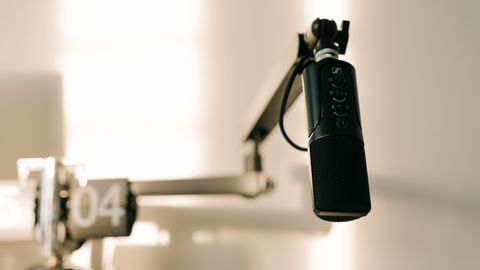
Text written to be read and text written to be heard follow different rules, and delivering the first aloud is why so many speeches sound like documents.
The core difference
What the listener lacks.
A listener cannot re-read, cannot skim, cannot see punctuation, and cannot control the pace.
Which means every sentence must be comprehensible on a single pass, in the order it arrives.
And it means structure must be carried by the words rather than by layout.
Sentence length
The first adjustment.
Shorter than written prose, substantially.
A sentence a listener cannot hold to its end has failed regardless of its content.
The practical test: read it aloud in one breath. If you cannot, it is too long.
And variation still matters — a run of short sentences becomes staccato — but the average should come down.
Sentence shape
More important than length.
Subject, verb, object, early.
Avoid long subordinate clauses before the main clause, since the listener is holding it all in suspense.
Avoid nesting.
Put the qualification after the statement rather than before: "we should do X, though the cost is uncertain" rather than "though the cost is uncertain, we should do X."
And end sentences on the strong word.
Signposting
Which replaces headings.
"There are three reasons. The first is…"
Numbering, stated and returned to.
Explicit transitions: "that is the problem; here is what I think we should do."
Summaries at intervals, which written text does not need and spoken text does.
And repetition, deliberately, since a listener who missed something has no way back.
Repetition as a tool
Which written editors remove and speech requires.
Repeating a key phrase gives the listener an anchor.
Repeating the structure of a sentence — the same shape three times — produces emphasis and is one of the oldest devices in rhetoric because it works.
Restating the point in different words gives a second chance at comprehension.
And the rule against repetition in written prose simply does not apply.
Words that work aloud
The lexical choices.
Concrete over abstract, since abstraction is harder to follow without the ability to pause.
Familiar over precise where the precision is not needed.
Short words, mostly.
Avoid words that are ambiguous when heard rather than read — homophones, and pairs that sound alike in context.
Avoid long strings of numbers, and round the ones you keep.
And avoid acronyms, which are opaque in speech even when familiar in print.
Punctuation for delivery
A different function.
In a script, punctuation marks breath rather than grammar.
Which means dashes and full stops used where a speaker would pause, even where a grammarian would not.
Line breaks between phrases.
Marking stressed words.
And writing out anything whose pronunciation you might fumble, phonetically, including names.
Testing it
The only reliable method.
Read it aloud, standing, at full delivery energy.
Mark every place you stumble, since a stumble indicates a sentence the mouth cannot manage.
Mark every place you ran out of breath.
Mark every place you instinctively rephrased, and take the rephrasing.
And read it to someone and ask them what the three points were, which reveals whether the structure survived.
Writing for someone else to deliver
A specific discipline.
Write in their idiom rather than yours, which requires listening to how they actually speak.
Avoid constructions they do not use.
Keep sentences within their comfortable breath length.
Give them the argument rather than only the words, so they can handle questions.
And expect them to change it, which is a sign it is being made their own rather than a rejection.
Audio and podcast writing
Where the constraints are tightest.
No visual support at all, and a listener who is frequently doing something else.
Which means more signposting, more repetition, shorter segments, and a clear structure stated at the start.
Scripted or unscripted both work; half-scripted generally does not, since the seams are audible.
And the opening thirty seconds determine whether anyone hears the rest, which is worth as much attention as everything after it.
Also by Rafael Duarte
- Sounding like yourself in another languageLanguages
- Silence and what it doesVoice & Accent
- What your voice tells peopleVoice & Accent
- Your voice as you get olderVoice & Accent