Public Speaking
Nerves before speaking, and what to do with them
Being told to relax has never helped anyone, and the techniques that do work are more specific than that.
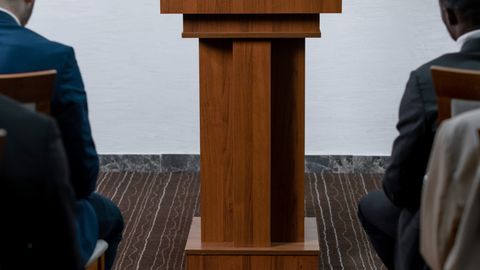
Surveys of common fears consistently place public speaking near the top, frequently above things that could actually kill you, which tells you something about how the fear operates.
What is actually happening
The physiology.
Standing in front of a group triggers a threat response: adrenaline, raised heart rate, shallow breathing, tension in the chest and throat, dry mouth, shaking hands, and blood diverted away from the extremities and the digestive system.
None of this is a malfunction — it is a system designed for physical danger, activating in response to social exposure.
Which means the symptoms are not evidence that something is wrong. They are evidence that your body has correctly identified that this matters to you.
Why relaxing does not work
The instruction is wrong.
Trying to move from high arousal to calm is a large transition and generally fails, which produces a second layer of anxiety about failing to relax.
Research on reappraisal suggests that reinterpreting the arousal as excitement rather than fear is more effective, because the physical state is nearly identical and only the interpretation differs.
Saying "I am excited" rather than "calm down" has been found in experimental work to improve performance in speaking and singing tasks.
Which is a small change and a genuinely different instruction.
The things that actually reduce it
In rough order of effect.
Preparation, which is the largest single factor.
Knowing your material thoroughly removes the fear of forgetting, which is the specific fear underlying most speaking anxiety.
Rehearsing out loud, standing, at full volume — not reading it in your head, which uses a different set of skills entirely.
Knowing the opening exactly, word for word if necessary, since the first thirty seconds is when arousal peaks and improvisation is hardest.
Arriving early and standing in the space, which converts an unfamiliar environment into a familiar one.
Speaking to people beforehand, which turns an audience into individuals.
Slow breathing with a longer exhale, which shifts autonomic balance measurably within a couple of minutes.
And movement beforehand — walking, using the stairs — which metabolises some of the adrenaline rather than leaving it circulating.
The physical symptoms specifically
Practical management.
Dry mouth: water beforehand, and avoiding caffeine, which increases arousal and dries the mouth.
Shaking hands: hold something, or use gesture, since visible shaking is generally far less noticeable to the audience than it feels.
Shallow breathing: deliberate slower breaths before starting, and pausing during rather than rushing.
Tight throat: yawning and gentle humming beforehand, which relaxes the mechanism.
And a racing start: consciously slowing the first two sentences, since almost everyone speeds up under adrenaline.
The spotlight effect
A useful piece of evidence.
Research on the spotlight effect consistently finds that people substantially overestimate how much others notice about them — appearance, mistakes, nervousness.
Studies asking speakers to rate how visible their anxiety was, and comparing with audience ratings, find speakers rating it considerably higher.
Which means the internal experience of nerves is largely invisible.
Knowing this does not remove the feeling and does reduce the secondary anxiety about being seen to be anxious.
Reframing the audience
What actually changes the experience.
Audiences want the speaker to do well, which is worth stating because most nervous speakers assume the opposite.
They are generally thinking about themselves, their day and whether the session will overrun.
They cannot see your notes, do not know what you intended to say, and will not notice an omission.
And shifting attention from how you are performing to whether they are understanding — from self-focus to audience-focus — reduces anxiety measurably, since self-focus is a core component of social anxiety.
When it is more than nerves
Worth distinguishing.
Ordinary performance anxiety improves with preparation and exposure.
Where the fear leads to avoiding opportunities, affects career or study, produces panic symptoms, or persists despite repeated experience, it may be closer to social anxiety disorder, which is common and treatable.
Cognitive behavioural approaches with graded exposure have strong evidence for this.
Which is worth knowing rather than concluding that you are simply not a speaker.
The practical sequence
Before the next one.
Prepare thoroughly and rehearse aloud.
Memorise the opening.
Arrive early and stand in the room.
Talk to a few people.
Move before you go on.
Breathe slowly with a long exhale.
Tell yourself you are excited rather than calm.
Start slower than feels natural.
And accept that the first two minutes are the worst and that it improves from there, which it almost always does.
Also by Esme Carrington
- The stories organisations tell about themselvesStorytelling
- Conversations with people much older or youngerConversation
- Speaking to cameraPublic Speaking
- Structuring a longer storyStorytelling