Voice & Accent
Reading aloud well
Reading written text aloud is a distinct skill, and the flatness most people produce has identifiable causes.
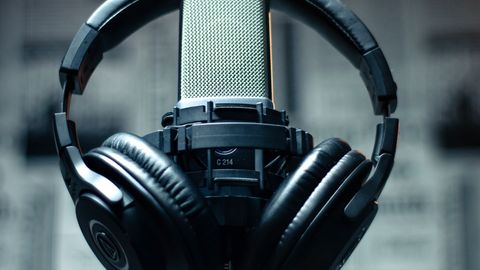
Whether it is a bedtime story, a scripted presentation or a recorded narration, reading aloud is not speaking and it is not reading — it is a third thing.
Why it comes out flat
The causes.
The eyes are working ahead while the voice produces, which splits attention.
Written sentences are longer and more complex than spoken ones, which makes phrasing harder.
There is no thinking time, so the natural pauses that structure speech are absent.
Anxiety about making a mistake produces a monotone, careful delivery.
And the meaning has not been decided, so the emphasis has nowhere to go.
Reading ahead
The core mechanical skill.
Your eyes should be a phrase or two ahead of your voice, which allows you to see the shape of the sentence before you begin delivering it.
Which is what makes it possible to know where the sentence is going and to phrase it accordingly.
It is trainable: practising deliberately, slowly, with attention to the gap, improves it within weeks.
And it is the difference between reading word by word and reading in units of meaning.
Phrasing
The second skill.
Speech naturally groups into phrases of a few words, with small breaks between them.
Reading badly ignores this and produces either a steady stream or breaks at the punctuation only.
Which means marking a text in phrases — with slashes, if it is a script — and pausing at those points rather than at commas.
Punctuation is a guide to grammar rather than to breath, and treating it as breathing instructions produces the characteristic reading voice.
Deciding the meaning
Which precedes delivery.
Every sentence has a word that carries the point, and which word it is depends on the meaning intended.
Which means reading the text beforehand and deciding, sentence by sentence, what is being said.
Marking the stressed word in each sentence of a script is standard practice among broadcasters and it works.
And a sentence read without a decision about its meaning comes out with even stress, which is the definition of flat.
Pace and variation
Which is what holds attention.
Slower than conversational speech, generally, since listeners have no visual support.
Varied: faster through familiar or connective material, slower through the important parts.
Pauses before something significant, which create anticipation.
Pitch variation, which is the main thing missing from most reading.
And volume changes, which are more effective than getting louder throughout.
Preparing a script
If you have one.
Read it aloud at least twice before delivering.
Rewrite anything that does not sit in the mouth, since text written to be read silently frequently cannot be spoken.
Shorten sentences.
Mark phrasing, stress and pauses.
Print in large type with wide spacing, and only on the top two thirds of the page so your head does not drop.
And number the pages, and do not staple them.
Reading to children
A distinct application.
Slower still, with more pitch variation than feels reasonable.
Distinct voices for characters, which need not be good, only different.
Pauses for looking at pictures.
Stopping to ask questions, which is what makes shared reading effective rather than merely pleasant.
And following their attention rather than finishing the book, since the point is the interaction.
Reading in a service or ceremony
Where nerves and acoustics both work against you.
Slower than you think, since reverberant spaces smear fast speech into incomprehensibility.
Longer pauses between sentences for the same reason.
Look up at the start and the end.
Know the pronunciation of every name in advance.
And read it aloud in the actual space beforehand if you possibly can, which tells you more than any amount of practice elsewhere.
Practising
How it improves.
Read aloud for ten minutes a day, from anything.
Record it and listen, which is the only honest feedback.
Read the same passage several ways, with different words stressed, to hear what emphasis does.
Read something you find genuinely interesting, since engagement is audible.
And listen to professional narrators with attention to their phrasing rather than their voices, which is what they are actually doing.
Also by Rafael Duarte
- Sounding like yourself in another languageLanguages
- Silence and what it doesVoice & Accent
- What your voice tells peopleVoice & Accent
- Your voice as you get olderVoice & Accent